
FMCSA made it official on September 1. Registration for 2027 opens October 1, 2026, and every fleet-size bracket costs more than it did last year.
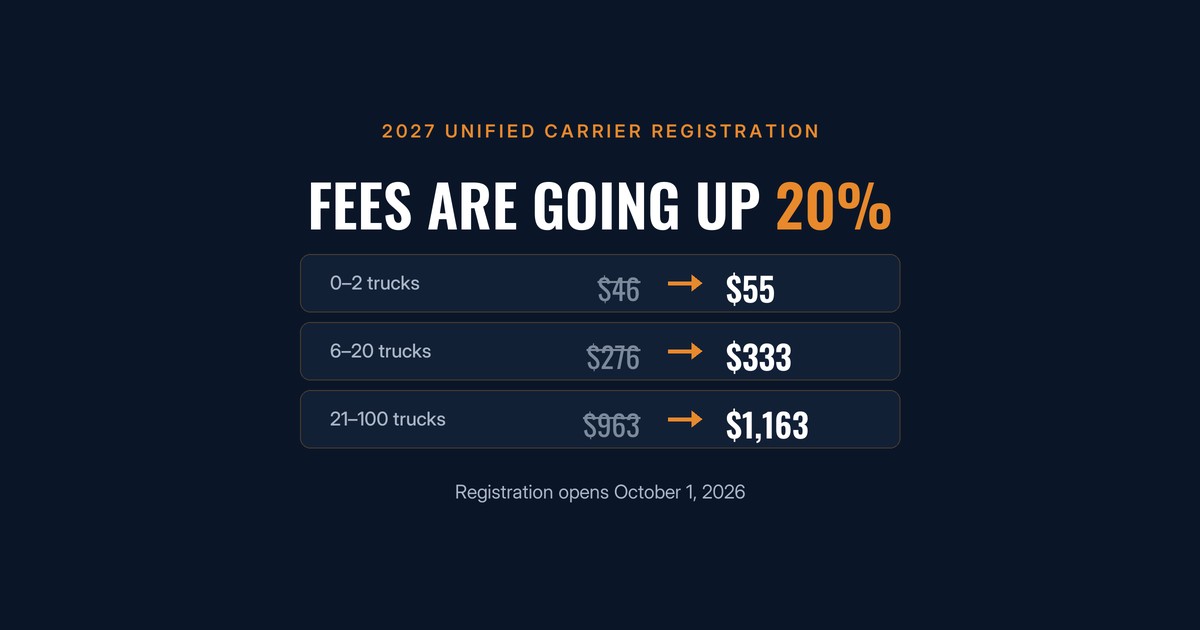
FMCSA published the final rule on September 1, 2026, adopting the UCR Board's recommended fee increase for the 2027 registration year. It averages 20 percent across the board, effective October 1, 2026. Registration for 2027 opens the same day, and enforcement starts January 1, 2027. If you have been paying $46 a year and mentally filing UCR under "rounding error," that number just went up -- and for larger fleets it went up a lot.
These are the final amounts, codified at 49 CFR 367.50, alongside what the same bracket cost for the 2025 and 2026 registration years:
Brokers and leasing companies pay the smallest-bracket fee -- $55 for 2027 -- regardless of how many vehicles are involved. That is set by statute, not by the Board, and FMCSA declined a comment asking it to charge large brokerages more, noting it has no authority to change it.
One piece of context worth knowing: even after this increase, 2027 fees are still lower than what carriers paid during the 2019 through 2022 registration years. The fee has bounced around for a decade. It is not a straight line up.
TruckWise files UCR for our clients every year, in the right bracket, before enforcement starts. Ask us to handle your 2027 registration.
When the gap between brackets was $138 and $276, a bracket error was annoying. At $333 versus $1,163, it is real money -- in either direction.
Fleet size for UCR purposes is based on the number of commercial motor vehicles you owned or operated, as reported on your most recent MCS-150. That trips people up two ways:
If your truck count has moved since your last MCS-150 biennial update, straighten that out before you register. The two filings feed each other.
Nothing, for a while. That is the trap. UCR is not a filing anybody chases you about -- there is no renewal notice, no email from FMCSA, no state reminder. It goes quiet until an officer at a scale house checks it.
Then it is fines that run from roughly $100 to $5,000 depending on the state, a possible hold on the vehicle until it is resolved, and an enforcement officer who now has a reason to look at everything else you carry. We wrote up the full picture in our guide to UCR deadlines and penalties.
The fee is going up. The cost of ignoring it did not change -- it was always higher than the fee.
Broader than most people assume. If you operate in interstate or international commerce, UCR applies to:
Purely intrastate operations generally fall outside it. One load across a state line generally does not.
For an owner-operator this is a $9 difference and a shrug. For a 60-truck fleet it is $200. For a 400-truck fleet it is nearly a thousand dollars you did not put in the 2027 budget. Pull the number for your bracket now while you are still planning next year, not on December 28 when you are trying to close the books.
And if UCR is one of six or eight filings you are personally tracking on a whiteboard, that is the actual problem. Here is what compliance really costs when you add up the filings, the time, and the things that get missed.